Marco Medina
MVC 201
“HIT ME!” … or don’t Sequence Analysis
The Dark Knight (2008) is an action-adventure thriller and was the second installment of a Batman trilogy directed by Christopher Nolan. The sequence below is from part of the film is where the protagonist Batman (Christian Bale) is facing off in an intense game of chicken against the antagonist Joker (Heath Ledger). The focus will be on the use of sound and Mise-en-scene.
The sequence begins with the camera fixated on Joker on the floor and then does a horizontal pan as he stumbles to his feet. The camera then follows Joker walking in the middle of the road with a camera facing and following the Joker from the front. The camera then cuts away to the Batman on his motorcycle rushing towards Joker. When Joker begins shooting his machine gun at the cars in his way the camera does a point of view shot to show the aftermath of the machine gun fire. For the most part, the camera work is very exceptional in capturing both perspectives of Batman and Joker. The camera cuts from both Batman to Joker in a shot-reverse-shot style that shows their facial expressions in this game of chicken. The lighting is very diluted because it is shot on a street at night with only the streetlights to provide adequate lighting.
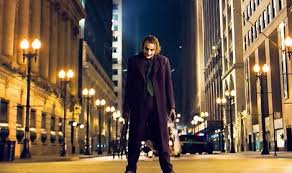
What is going on within the scene? The sequence perfectly characterizes both Joker and Batman. The Joker is clearly shown as intense and psychotic with his wanting to be hit by the Batman on his bike while still recovering from a car crash that had happened on the scene before this one. The crazy nature of the Joker’s character is also shown by his response to one of his henchmen being electrocuted. The henchman is electrocuted and then the Joker laughs maniacally and spits on the henchman. The character of Batman is the opposite but similar in his intensity. Batman does not want to hit the Joker and crashes instead. Batman does not kill anybody while the Joker kills everybody.
The sound that is heard in the scene comes also develops the character and really elevates the scene. In terms of Diegetic sound, the street sounds are heard audibly by both characters. This means that the sound of cars driving, and, in this case, crashing is heard by the characters. The sound of the Batman on his motorcycle is heard on screen. The bullets from the shots are both heard and shown on screen. The dialogue of the Joker repeatedly saying “Hit me” is also diegetic. Batman in this entire sequence does not speak and only yells in frustration at the fact he will not hit the Joker.
The non-diegetic noise is in this sequence is the important aspect which creates a lot of suspense. When the Joker begins walking towards Batman on his motorcycle the music score is very faint. Then as the camera cuts between Joker and Batman it gradually becomes louder and overpowering of the diegetic sound in the scene. When the Batman crashes behind the Joker, however, the music makes an abrupt stop and it is silent. The silence is then broken when the Joker takes out his knife and approaches the Batman who is on the floor presumably knocked unconscious. A henchman touches Batman’s helmet and an audible electric shot is shown which triggers the laugh of Joker. The sequence ends with a shotgun being cocked and a police officer arresting the Joker.
This scene is approximately one minute and eleven seconds. With this time, I know the main conflict is between Batman and Joker, and that like this sequence was very high stakes. The Dark Knight is one of the best comic book movies ever made in my opinion, and with scene alone is evidence why. It captivates the audience with its raw intensity and its electrifying performances. The protagonist does not even say one word in this entire sequence, and I know that he is the good guy. The one dressed in a purple suit, make-up, and a machine gun I automatically knew that this was one psychotic villain. To contain so much suspense in a scene at the illusion that the Hero was or was not going to run over the villain. This movie overall is about choices and the philosophy of human nature. To be good or not to be good, and in this very Shakespearean concept the audience gets a good sense of what this movie will be about. Overall this scene is rated the same this movie is with being five out of five stars.


 Marco's Movies MVC 201