The structure of the Romantic comedy has been played
out for years. Hollywood has a formula where the protagonist must win the love
interest surrounding some type of conflict. In the film (500) Days of Summer (Webb 2009), this is a unique approach that
stirs up the traditional way of telling a “Love story”. For the sake of
argument, most of these romantic stories have to do with a heterosexual
relationship.Roger Ebert in his
movie review explains the Hollywood trip “When we realize she is not required
to in this movie, because it’s not playing by the Hollywood rules, we perk up;
anything could happen. The kaleidoscopic time structure breaks the shackles of
the three-act grid and thrashes about with the freedom of romantic confusion”
(Website). The audience throughout the film is not given the traditional
beginning, middle, and end of the film. The movie is broken up in days that the
protagonist is in some type of relationship with the female love interest. This
gives the audience barely any indication of how the events of this romantic
roller coaster of a relationship will play out. This keeps the audience
captivated by the idea of will they or won’t they.
(500) Days of
Summer Movie Review (2009) | Roger Ebert
Wright, Georgie. “How
‘500 Days of Summer’ Highlights the Double Standards in Rom-Coms.” I, VICE, 10
Aug. 2018,
i-d.vice.com/en_us/article/bjbpv4/how-500-days-of-summer-highlights-the-double-standards-in-rom-coms-movies.
500
Days of Summer (Webb 2009) redefines the genre of what it means to be a
romantic comedy. The film tells the ups and downs of a relationship between the
characters Tom (Joseph Gordan-Levitt) and Summer (Zooey Deschanel). This is not
the typical chronological depiction of boy meets or girl or vice versa, but
rather told in the male protagonist perceived view of the relationship told in
a series of flashbacks. In first viewing of the film you feel sorry for main character,
but as the film goes on the audience becomes less sympathetic towards him. This
film style presents itself more as an anti-romantic comedy.
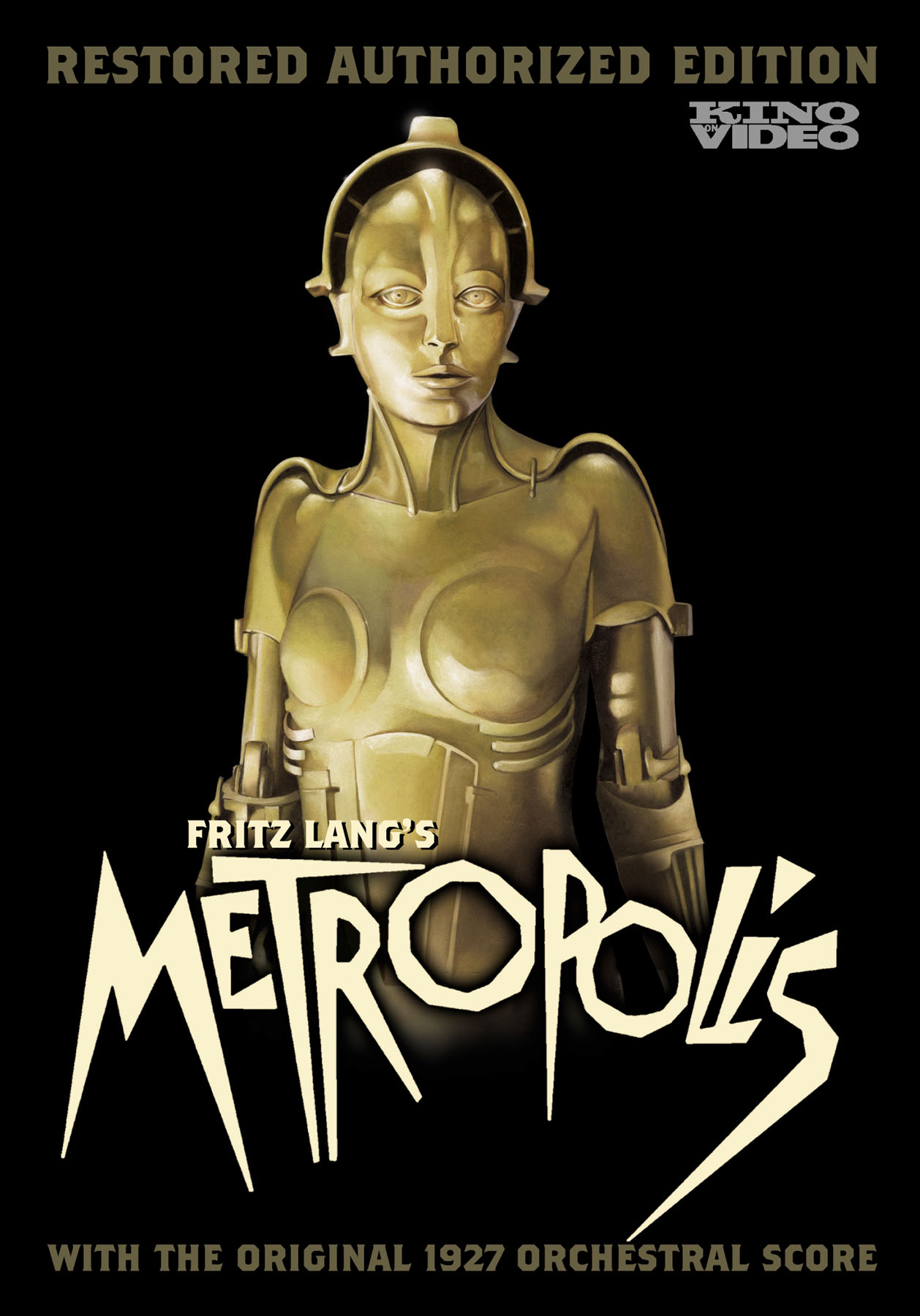
Metropolis (Lang, 1927) is a silent German expressionist film
that pioneered the way for the modern genre of science fiction. The film
depicts a visually stylistic dystopia where the people only have two classes:
the upper and working class. The upper-class lives in the industrious and beautiful
city of Metropolis while the working-class lives and work in the decrepit
underground city. This film highlights the society by it distinguishing the
clear economic gap and lifestyles of the people living above and below the
city. Characters from the film are meant to portray the values of society.
According to the film greed and ambivalence of the upper class causes
resentment and injustice for the working class.M
Lang transports the audience to the futuristic city and
cinematic marvel that is Metropolis. The
city itself is a technological marvel showcasing skyscrapers, automobiles, and even
its own interpretation of a Garden of Eden. The setting is more than what meets
the eye with its expression of both the main city and the city that is under the
surface. This underground city is its own society where the working class must
live and work for the people living in the upper levels of the city. Money, status,
and materialism are what is valued by the upper classes, while the underground workers
are living shift to shift in an unending cycle of mundaneness. The philosophy that
Lang is criticizing is the capitalistic mindset which the society he lived in
during his time in the late 1920s which is a destitute post world war 1 Germany.
This film is a comment on society using tactics that influenced the science
fiction genre for years to come.
The main protagonist is Freder (Gustav Fröhlich), a
young man from the upper class and the son of the mayor of Metropolis. In one
of the beginning sequences, the audience sees that Freder is frolicking through
a “Garden of Eden” with the rest of the aristocratic persons. The initial
impression of this character is one of privilege and excess. He is totally
unaware of his advantageous lifestyle and that there is an entire society
working for him. All was well in his world before because ignorance is bliss.
It is not until Freder sees the female protagonist for the first time where he
becomes remotely curious about what is it like in the city that is underground.
To find the girl, he makes his way beneath the city.
When Freder submerges to the underground city he gets
a reality check of the truly horrific conditions in which the working class is
subjugated to. In his first impression of the workers, he imagines that the
workers are all willingly walking to their death. This scene is graphic with
him watching in horror as the workers willingly go to work. The way Freder
views the working class further emphasizes the obvious disconnect between both
classes. To understand the work life and find the mysterious girl that caught
his attention he trades lives with one of the workers. Having no manual labor
work experience, Freder still performs a full ten-hour shift. All the while the
worker whom he trades lives with for the day is overwhelmed by the amount of
luxury and pleasures of the flesh.
The sequence of Freder working on a machine after
trading clothes with a worker is one pivotal scene. They switch lives for a
moment. The scene begins with the worker struggling to maintain the machine he
is working. In this sequence, the camera cross-cuts between him and his father.
Man, the versus machine is another thing in which is addressed. The people are
not machines.
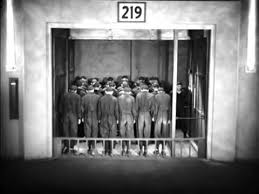
The workers in the movie are the true unsung heroes of this film. The introduction sequence begins with a horde of workers going towards an elevator to bring them down to the underground levels. They all move in unison and mechanically, and like clockwork are replaced by the next person as if they were on an assembly line. The workers live day to day, or more likely shift to shift. All the workers are portrayed as decrepit and with their heads down. It implies that the life that they are in is the only option they have, and nothing can be done to change their circumstance. This feeling of inadequacy blankets the whole of the working class except for the love interest of Maria. To instill that the station in life that they were dealt with is not the one that they must live with. This idea of human worth over financial gain is what she wants to instill in people.
The clothing and costume design of the film also helps
to distinguish the class differences. Most of the cast are workers. The workers
are all dressed in the same uniform costume. The uniform consists of a jumpsuit
and a cap to signify that they are workers. This represents sameness and
implies that they are replaceable. Each jumpsuit is numbered and is probably
just a number and not a name in the underground city. The upper class all have
a bit more glamourize clothing. The men with tuxedos and suits and the women
with jewelry and dresses. Very plain as opposed to extravagant is the main
difference in the clothes. The aboveground society is very materialistic
compared to the very plain and simple lifestyle that the underground society
must live.
The female protagonist Maria (Brigitte Helm) is an
activist who preaches against the divide between the two classes (Pfeiffer,
Lee). In the film, she plays pivotal roles which symbolizes many different
aspects of society. For Freder she is the woman that he falls in love at first
sight. This is seen as forbidden love because he is from the above ground city
and she is from the underground city. For the workers, she is the spiritual
leader that believes that they are valuable and worthy of living above ground.
In the eyes of Maria, both workers and the citizens living in the upper levels
are equal or should be treated as such.
This
ideology of equality does not adhere to the present-day rulers, so Freder’s
father asks for assistance from an evil scientist name Rotwang. For the upper
level’s society, she is evil and a temptress. Rotwang, an inventor, creates a
robot with the body of Maria, with the goal in mind of destroying her
reputation among those workers below. The robot version is hypersexualized and
makes the lustful nature of the upper class seem apparent. It is meant to
create chaos and puts into perspective the value of sexual and financial gain.
The film that follows Freder’s journey into the
exploration of both the working class and upper-class citizens as complex a
character as Maria is, she is presented as a strong female lead A revolution soon ensues as the working
class gets called to action by Maria and Freder. Freder in the quest for
Maria’s heart begins to recognize the injustice of the lifestyles between both
classes of people. The value of people is what is truly addressed throughout
the film.
In it we are shown two distinct classes, their
existences entirely separated. There is the class of thinkers, who generate
ideas for the sake of the city and their civilization, and there is then the
class of the workers, who carry out and act upon these enterprises. It is
relatively like Marxist theory, where the workers are readily identifiable.
They act in accordance with the proposed archetypes that belong to the
political philosophy of Karl Marx. This being the ideology in which classes
should be more equal. Government and capitalistic I believe that the film is critiquing the
unequal nature of capitalism and taking it to its ultimate logical conclusion,
an entirely separated world of socio-economic ability.
Religion is imperative for the working class. As
stated before, the original Maria is seen as a beacon of hope and is looked on
by the underground workers as a leader of a great exodus. She refers to the
tower of Babel in which is a biblical story of men wanting to create a tower to
reach the heavens to meet their creator. The lighting on her, whenever she
gives a sort of motivational speech, seems to also surround her like a halo. In
the upper levels of Metropolis, when a robot Maria is introduced, she just
wreaks havoc on the world above. The robot Maria uses her physical looks to get
the men of the upper class riled up. The seven deadly sins then are depicted
within the film when pandemonium strikes.
The portrayal of class in this film is very apparent.
It relies on these class hierarchies to function as a society. The images are
visually striking, and the film seems to be dealing with the nature of work
itself. It analyzes the nature of dehumanization within an increasingly
industrialized society. The people must deal with prodigious amounts of work.
The separation of the thinking leader from his workforce creates this abstract
acknowledgment of their existence. We can assume before the film takes place
that the thinkers seldom traverse into the murky depth of the subterranean
workforce’s city and the world. They have no real connection with their
lifestyle and their existence. To the thinkers, it is only a means to an end.
And the end of their means is barely evident. What could the thinkers possibly
be striving for? To continue the widening of the ravine between the two
classes? The ethics of how people are treated shows the values of the people in
distinct classes.
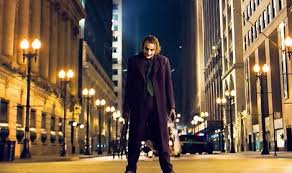
The Dark Knight (2008) is an action-adventure thriller and was the second installment of a Batman trilogy directed by Christopher Nolan. The sequence below is from part of the film is where the protagonist Batman (Christian Bale) is facing off in an intense game of chicken against the antagonist Joker (Heath Ledger). The focus will be on the use of sound and Mise-en-scene.
The sequence begins with the camera fixated on Joker on the floor and then does a horizontal pan as he stumbles to his feet. The camera then follows Joker walking in the middle of the road with a camera facing and following the Joker from the front. The camera then cuts away to the Batman on his motorcycle rushing towards Joker. When Joker begins shooting his machine gun at the cars in his way the camera does a point of view shot to show the aftermath of the machine gun fire. For the most part, the camera work is very exceptional in capturing both perspectives of Batman and Joker. The camera cuts from both Batman to Joker in a shot-reverse-shot style that shows their facial expressions in this game of chicken. The lighting is very diluted because it is shot on a street at night with only the streetlights to provide adequate lighting.
What is going
on within the scene? The sequence perfectly characterizes both Joker and
Batman. The Joker is clearly shown as intense and psychotic with his wanting to
be hit by the Batman on his bike while still recovering from a car crash that
had happened on the scene before this one. The crazy nature of the Joker’s
character is also shown by his response to one of his henchmen being
electrocuted. The henchman is electrocuted and then the Joker laughs maniacally
and spits on the henchman. The character of Batman is the opposite but similar
in his intensity. Batman does not want to hit the Joker and crashes instead.
Batman does not kill anybody while the Joker kills everybody.
The sound that is heard in the scene comes also develops the character and really elevates the scene. In terms of Diegetic sound, the street sounds are heard audibly by both characters. This means that the sound of cars driving, and, in this case, crashing is heard by the characters. The sound of the Batman on his motorcycle is heard on screen. The bullets from the shots are both heard and shown on screen. The dialogue of the Joker repeatedly saying “Hit me” is also diegetic. Batman in this entire sequence does not speak and only yells in frustration at the fact he will not hit the Joker.
The
non-diegetic noise is in this sequence is the important aspect which creates a
lot of suspense. When the Joker begins walking towards Batman on his motorcycle
the music score is very faint. Then as the camera cuts between Joker and Batman
it gradually becomes louder and overpowering of the diegetic sound in the
scene. When the Batman crashes behind the Joker, however, the music makes an
abrupt stop and it is silent. The silence is then broken when the Joker takes
out his knife and approaches the Batman who is on the floor presumably knocked
unconscious. A henchman touches Batman’s helmet and an audible electric shot is
shown which triggers the laugh of Joker. The sequence ends with a shotgun being
cocked and a police officer arresting the Joker.
This scene is approximately one minute and eleven seconds. With this time, I know the main conflict is between Batman and Joker, and that like this sequence was very high stakes. The Dark Knight is one of the best comic book movies ever made in my opinion, and with scene alone is evidence why. It captivates the audience with its raw intensity and its electrifying performances. The protagonist does not even say one word in this entire sequence, and I know that he is the good guy. The one dressed in a purple suit, make-up, and a machine gun I automatically knew that this was one psychotic villain. To contain so much suspense in a scene at the illusion that the Hero was or was not going to run over the villain. This movie overall is about choices and the philosophy of human nature. To be good or not to be good, and in this very Shakespearean concept the audience gets a good sense of what this movie will be about. Overall this scene is rated the same this movie is with being five out of five stars.
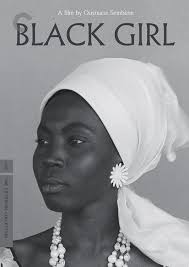
The film Black Girl (1965), written and directed by Ousmane Sembène, focuses on a young woman from Senegal named Diouana adjusting to life in the French Rivera. In this mostly narrated film, it expresses the thoughts and feelings of Diouana and her pursuit of a better life. The bleakness of the film not only expressed by the acting of the film but by the opposites of setting that is shown through the being shot in both Senegal and the French Rivera. This film is not for that audience that use movies to escape reality for the sake of recreation and entertainment. This is an artistic film in which cultural appropriation is addressed and the effects of post-colonialism.
Black Girl begins with the protagonist Diouana arriving at the French Rivera dressed to impress in a sophisticated dress and heels. She stands out not only by the fact she is the only person from Africa in the vicinity but by the pride she feels in being in France. She is picked up by her one of her French employers, and when she arrives, she is immediately put to work as a maid. This causes a lot of confusion and resentment for Diouana because in Senegal she was hired by the same employers to be a governess. This was not the case because the children were not present for most of the time that she is working in the home of her employers. A discontentment of her living and working situation that very closely resembles domestic slavery is mistaken for laziness and creates friction between the employers and Diouana. A tragic end was inevitable in this very bleak and dark film.
In this hour-long depiction of life, the audience is shown Diouana sifting through her life. The film tells through a series of flashbacks and a narration style that alludes that Diouana is talking to the audience. I found this narration style an interesting way of progressing the story. There is very little dialogue that is said between the employers and Diouana. There is no form of resistance to how the employers treat Diouana until the very end of the film. The employers portray different characteristics in the different environments that they were put in. They collect artifacts from the country that they are visiting and appropriate the culture by hanging up said artifacts at decoration. The only difference is that when the employers finally return home to the French Rivera they not only have “authentic” African memorabilia but also a worker from Senegal. One of the artifacts that creates a lot of symbolism is the mask that Diouana gifts to her employers as a gesture of appreciation for the job. In doing so, however, they display it on their wall without any sort of reverence and treat it as just another souvenir.
They mistreated Diouana in the French Rivera. In Senegal, the employers gave her a vision and hope of life that is better than the life that she was in the freshly made independent area of Senegal. Unfortunately, even with the country’s independence from France, they are still looked down upon based on the color of there skin. An attitude of entitlement is clearly expressed by the employers in the film. It was expressed in one scene where Diouana is tasked to make a nice dinner for her employers and their guests. She does as she is told, and the employers tell their guest that they are eating a traditional African dish. Status and to show how cultural these employers have they feel they need to flaunt that they have an exotic employee named Diouana from a far-off land. She was treated as one of the souvenirs because she was shown off for the company and used by the employers for things that it probably was not originally be intended for.
This movie which was made in 1966 and one of the first films that come from African cinema. The movie was shot in black and white. This was a stylistic choice that the director wanted to portray in this film. This gives a greater contrast of visuals because She is given tasks of washing and cleaning that are shown in montage format to express the mundaneness of her tasks that she was forced to do. The scenes filmed in the French Rivera are very boring with very little action taking place. There is just a steady cam on Diouana recording her sleep, eat, and do chores. The contrast of the camera work when scenes were shot in Senegal. The scenes in Senegal was livelier and more expressed Diouana more with personality and with vigor. The camera work seemed to be more handheld and shaky because the camera followed Diouana from place to place.
The film was not my favorite of the films I was suggested to watch. To tell the truth I felt bored when I was watching the movie. I was upset that the character Diouana just accepted that this was a life she deserved. I felt that she should have left her situation and logically it did not make any sense to me what her alternative to quitting the job. I was caught off guard by the abrupt climax of the movie. The film did not really create a sensation of fulfillment that I am accustomed to receiving when I go to watch a movie. The ambiguity of what happens to the characters after what seems to be the conclusion made me feel rather depressed and feel like there is no justice in the world. The audience for this film needs to know that this movie progresses at a very slow pace with very little action. The conflicts are mainly internal and not addressed by the external. The language barrier between cultures is addressed. To put in plain terms, watch this movie with an open mind and if you wish to educate yourself on issues that do not usually receive a platform. I did not hate this movie, and I think it is worth watching whether you are a media buff or not. I give this film a three out of five stars.
Take a moment to think about the film that we watched for our first screening. As a way of introducing your audience to your blog and its perspective, write about this film a little. What was your take on the film? How did you feel about it? Did you hate it? Love it? Were you bored? Feel free to say whatever you like about the film.
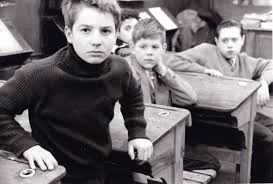
The 400 Blows (1959), directed by Truffaut, a film shot in black and white follows young adolescent Antione Dionel (Jean-Pierre) journey of self-worth and self-discovery. We get an in-depth look into the young Antione’s trials of growing up. From the very beginning of the film, Antione gets targeted for punishment by the adults in his life. Antoine rebels at every turn whether its the teacher, parents, or even the police. He does not feel a sense of belonging anywhere, so the natural instinct for this young trouble maker is to run away.
Antoine Doniel and schoolmates
Running away a major element in this movie that begins the French New Wave. Instead of facing the consequences of the decisions this protagonist makes. Antoine’s first response is to deny, lie, and run away. This lifestyle eventually brings about the downfall of this young man when he is eventually put in a facility for juvenile boys. To say that was this was a coming of age story would not be too far off.
My interpretation of the movie is that I was very intrigued in the way it told this very unique story. I was actually interested and invested in the story of this young boy. The story itself is just so bleak and so hopeless that it makes the audience feel depressed after. The abrupt ending of this movie creates an ambiguity which made me as an audience member thinking of all the things this boy Antoine had gone through. I personally enjoyed watching this film. It was a story I had to really pay attention to because of the fact that it was in a foreign language, so I had to see read the subtitles and see what was going on at the same time.
My name is Marco Medina and this is my blog. I am a Junior at the University of Redlands currently working on my Media and Visual Culture major Undergraduate degree. I have always been into movies and television growing up, and I thought this would be a good fit since my original intention was to get a communications degree from Cal State Fullerton. In this Blog, I will review and give my interpretations of movies that my class is required to screen in this MVC 201 class. I am in no way a leading expert in the field of cinema so these reviews will be not as scholarly, however, it will be a blend of my own rhetoric and writing style. Please Enjoy!



 Marco's Movies MVC 201