Marco Medina
2/23/19
MVC 201
Academic Analysis: Metropolis
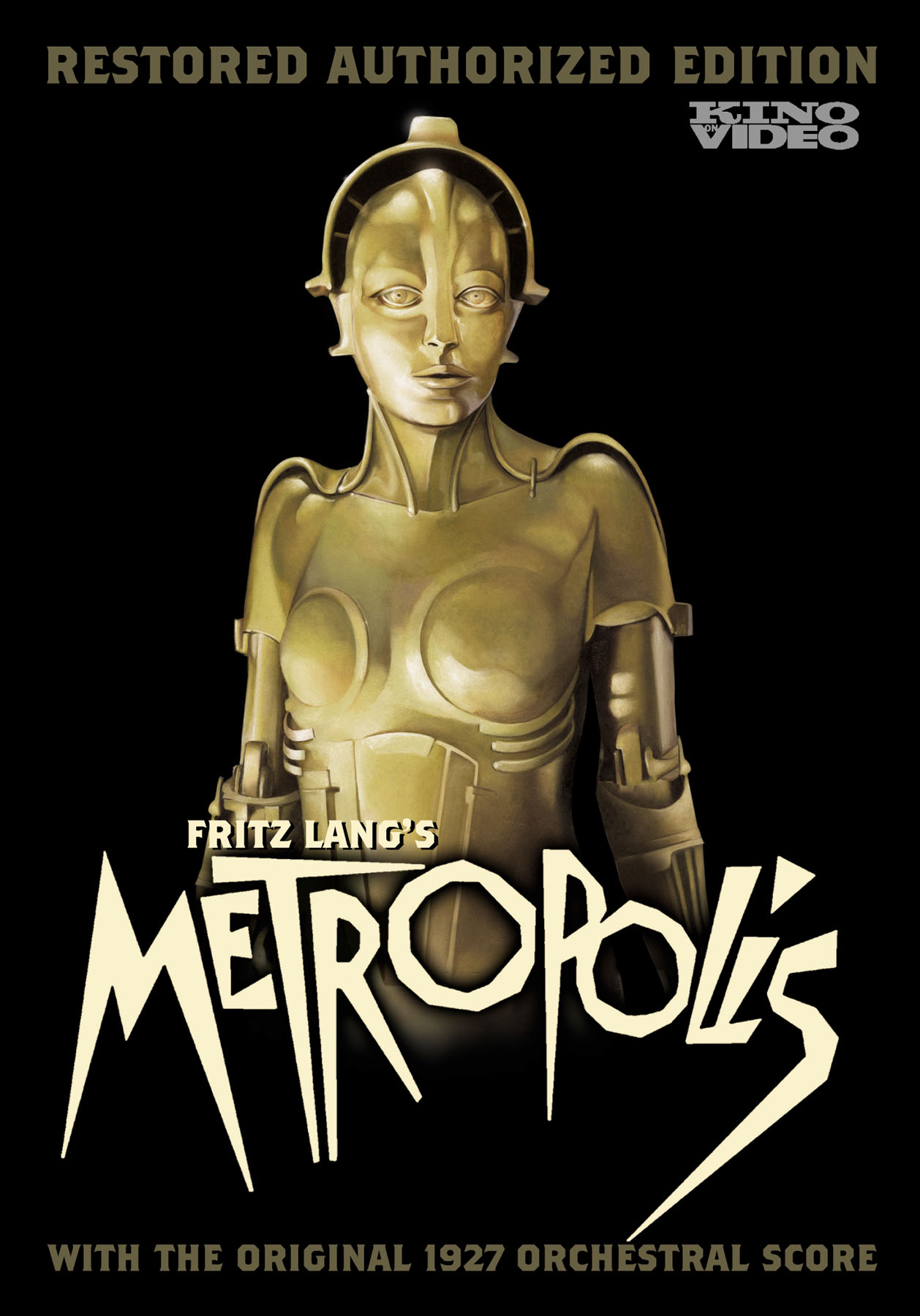
Metropolis (Lang, 1927) is a silent German expressionist film that pioneered the way for the modern genre of science fiction. The film depicts a visually stylistic dystopia where the people only have two classes: the upper and working class. The upper-class lives in the industrious and beautiful city of Metropolis while the working-class lives and work in the decrepit underground city. This film highlights the society by it distinguishing the clear economic gap and lifestyles of the people living above and below the city. Characters from the film are meant to portray the values of society. According to the film greed and ambivalence of the upper class causes resentment and injustice for the working class.M
Lang transports the audience to the futuristic city and cinematic marvel that is Metropolis. The city itself is a technological marvel showcasing skyscrapers, automobiles, and even its own interpretation of a Garden of Eden. The setting is more than what meets the eye with its expression of both the main city and the city that is under the surface. This underground city is its own society where the working class must live and work for the people living in the upper levels of the city. Money, status, and materialism are what is valued by the upper classes, while the underground workers are living shift to shift in an unending cycle of mundaneness. The philosophy that Lang is criticizing is the capitalistic mindset which the society he lived in during his time in the late 1920s which is a destitute post world war 1 Germany. This film is a comment on society using tactics that influenced the science fiction genre for years to come.
The main protagonist is Freder (Gustav Fröhlich), a young man from the upper class and the son of the mayor of Metropolis. In one of the beginning sequences, the audience sees that Freder is frolicking through a “Garden of Eden” with the rest of the aristocratic persons. The initial impression of this character is one of privilege and excess. He is totally unaware of his advantageous lifestyle and that there is an entire society working for him. All was well in his world before because ignorance is bliss. It is not until Freder sees the female protagonist for the first time where he becomes remotely curious about what is it like in the city that is underground. To find the girl, he makes his way beneath the city.
When Freder submerges to the underground city he gets a reality check of the truly horrific conditions in which the working class is subjugated to. In his first impression of the workers, he imagines that the workers are all willingly walking to their death. This scene is graphic with him watching in horror as the workers willingly go to work. The way Freder views the working class further emphasizes the obvious disconnect between both classes. To understand the work life and find the mysterious girl that caught his attention he trades lives with one of the workers. Having no manual labor work experience, Freder still performs a full ten-hour shift. All the while the worker whom he trades lives with for the day is overwhelmed by the amount of luxury and pleasures of the flesh.
The sequence of Freder working on a machine after trading clothes with a worker is one pivotal scene. They switch lives for a moment. The scene begins with the worker struggling to maintain the machine he is working. In this sequence, the camera cross-cuts between him and his father. Man, the versus machine is another thing in which is addressed. The people are not machines.
The workers in the movie are the true unsung heroes of this film. The introduction sequence begins with a horde of workers going towards an elevator to bring them down to the underground levels. They all move in unison and mechanically, and like clockwork are replaced by the next person as if they were on an assembly line. The workers live day to day, or more likely shift to shift. All the workers are portrayed as decrepit and with their heads down. It implies that the life that they are in is the only option they have, and nothing can be done to change their circumstance. This feeling of inadequacy blankets the whole of the working class except for the love interest of Maria. To instill that the station in life that they were dealt with is not the one that they must live with. This idea of human worth over financial gain is what she wants to instill in people.
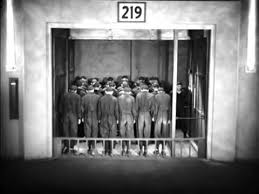
The clothing and costume design of the film also helps to distinguish the class differences. Most of the cast are workers. The workers are all dressed in the same uniform costume. The uniform consists of a jumpsuit and a cap to signify that they are workers. This represents sameness and implies that they are replaceable. Each jumpsuit is numbered and is probably just a number and not a name in the underground city. The upper class all have a bit more glamourize clothing. The men with tuxedos and suits and the women with jewelry and dresses. Very plain as opposed to extravagant is the main difference in the clothes. The aboveground society is very materialistic compared to the very plain and simple lifestyle that the underground society must live.
The female protagonist Maria (Brigitte Helm) is an activist who preaches against the divide between the two classes (Pfeiffer, Lee). In the film, she plays pivotal roles which symbolizes many different aspects of society. For Freder she is the woman that he falls in love at first sight. This is seen as forbidden love because he is from the above ground city and she is from the underground city. For the workers, she is the spiritual leader that believes that they are valuable and worthy of living above ground. In the eyes of Maria, both workers and the citizens living in the upper levels are equal or should be treated as such.
This ideology of equality does not adhere to the present-day rulers, so Freder’s father asks for assistance from an evil scientist name Rotwang. For the upper level’s society, she is evil and a temptress. Rotwang, an inventor, creates a robot with the body of Maria, with the goal in mind of destroying her reputation among those workers below. The robot version is hypersexualized and makes the lustful nature of the upper class seem apparent. It is meant to create chaos and puts into perspective the value of sexual and financial gain.
The film that follows Freder’s journey into the exploration of both the working class and upper-class citizens as complex a character as Maria is, she is presented as a strong female lead A revolution soon ensues as the working class gets called to action by Maria and Freder. Freder in the quest for Maria’s heart begins to recognize the injustice of the lifestyles between both classes of people. The value of people is what is truly addressed throughout the film.
In it we are shown two distinct classes, their existences entirely separated. There is the class of thinkers, who generate ideas for the sake of the city and their civilization, and there is then the class of the workers, who carry out and act upon these enterprises. It is relatively like Marxist theory, where the workers are readily identifiable. They act in accordance with the proposed archetypes that belong to the political philosophy of Karl Marx. This being the ideology in which classes should be more equal. Government and capitalistic I believe that the film is critiquing the unequal nature of capitalism and taking it to its ultimate logical conclusion, an entirely separated world of socio-economic ability.
Religion is imperative for the working class. As stated before, the original Maria is seen as a beacon of hope and is looked on by the underground workers as a leader of a great exodus. She refers to the tower of Babel in which is a biblical story of men wanting to create a tower to reach the heavens to meet their creator. The lighting on her, whenever she gives a sort of motivational speech, seems to also surround her like a halo. In the upper levels of Metropolis, when a robot Maria is introduced, she just wreaks havoc on the world above. The robot Maria uses her physical looks to get the men of the upper class riled up. The seven deadly sins then are depicted within the film when pandemonium strikes.
The portrayal of class in this film is very apparent. It relies on these class hierarchies to function as a society. The images are visually striking, and the film seems to be dealing with the nature of work itself. It analyzes the nature of dehumanization within an increasingly industrialized society. The people must deal with prodigious amounts of work. The separation of the thinking leader from his workforce creates this abstract acknowledgment of their existence. We can assume before the film takes place that the thinkers seldom traverse into the murky depth of the subterranean workforce’s city and the world. They have no real connection with their lifestyle and their existence. To the thinkers, it is only a means to an end. And the end of their means is barely evident. What could the thinkers possibly be striving for? To continue the widening of the ravine between the two classes? The ethics of how people are treated shows the values of the people in distinct classes.
Works Cited
Pfeiffer, Lee. “Metropolis.” Encyclopædia Britannica, Encyclopædia Britannica, Inc., 14 Dec. 2016, http://www.britannica.com/topic/Metropolis-film-1927.
“Metropolis (1927 Film).” Wikipedia, Wikimedia Foundation, 17 Feb. 2019, en.wikipedia.org/wiki/Metropolis_(1927_film)#In_popular_culture


